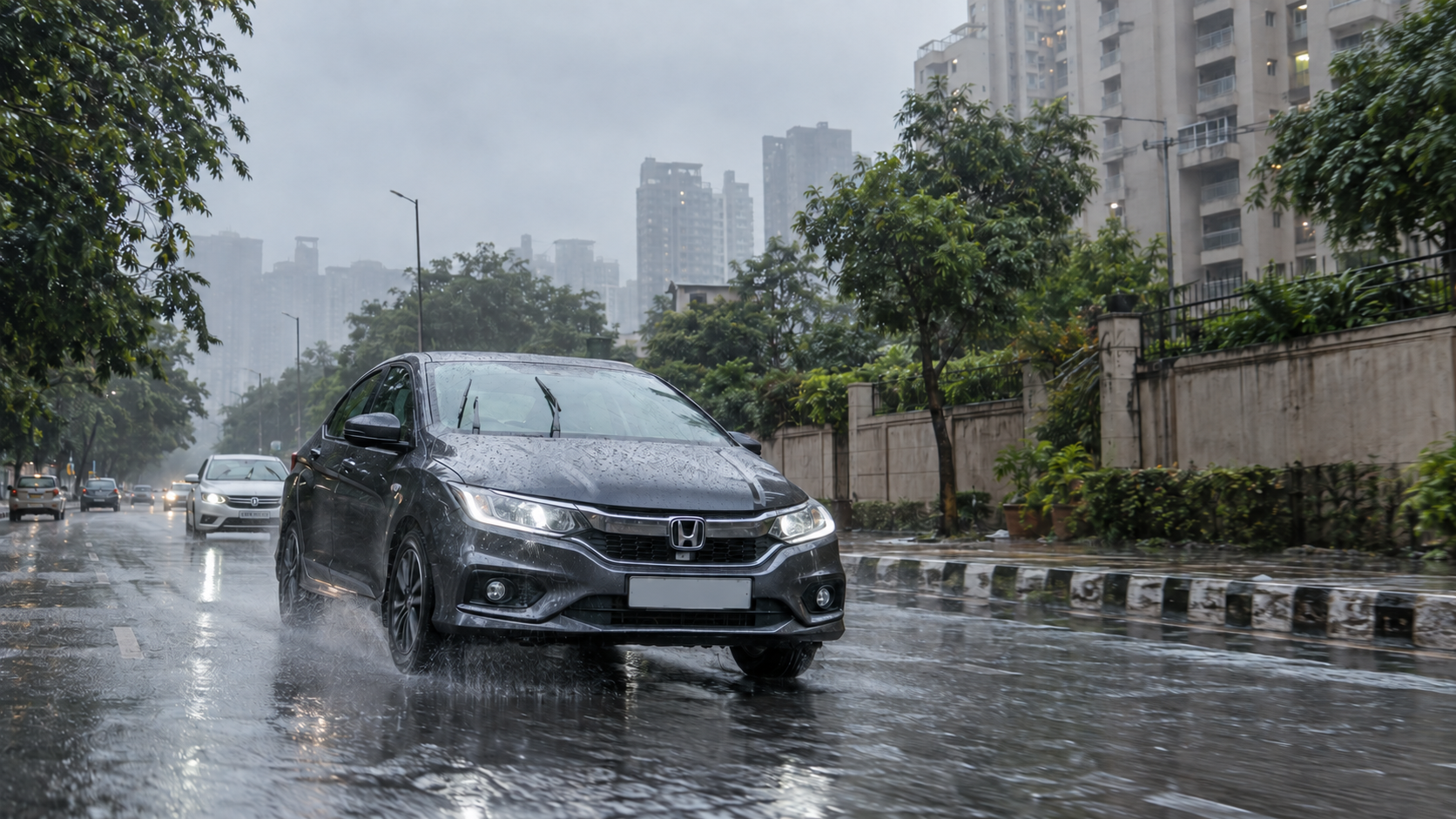
The rains have stopped, the roads are drying out, and most drivers assume the hard part is over, especially in cities like Gurugram where waterlogged streets, submerged underpasses, and potholes hidden under standing water were simply part of daily life for most of this monsoon season.
Months of relentless rain meant cars were regularly pushing through standing water deep enough to force moisture into wheel bearings, brake assemblies, and underbody electrical connectors, while tyres were absorbing impacts from kerbs and potholes completely invisible under the surface.
What most people don’t realise is that monsoon damage rarely makes itself known during the season itself. It develops quietly, and in North India the residual humidity of October and November means condensation is still forming inside components even when the sky is clear. Corroded calliper pistons, contaminated wheel bearing grease, compromised tyre sidewalls, degraded electrical connectors. None of these shows up on a dashboard; they show up weeks or months later, when something finally fails. By then the monsoon feels like a distant memory, and nobody connects the two.
Five Things the Monsoon Might Have Left Behind
1) Brake Calliper Corrosion
During the monsoon, your brakes go through far more exposure to water, moisture, mud and road grime than they normally do. While some surface rust on exposed brake components is normal, repeated exposure can accelerate corrosion around the calliper, its hardware and moving parts. The problem isn’t the rust you can simply see; it’s when corrosion starts affecting how those components move and operate.
A brake calliper needs to apply the pads evenly and release them properly once you lift off the brake pedal. If corrosion restricts the movement of components such as the calliper slides or related hardware, the brake pad may not retract as it should. That can leave the pad lightly rubbing against the disc even when you’re no longer braking, creating unnecessary friction and heat.
You may notice uneven brake-pad wear, the car pulling slightly under braking, a burning smell, or one wheel feeling noticeably hotter than the others. In more severe cases, a dragging brake can affect braking consistency and accelerate wear on the pads and disc. So after a wet monsoon season, the brakes are worth a closer look than most people give them.
2) Wheel Bearing Seal Degradation
Wheel bearing damage from monsoon exposure is one of the most delayed consequences a driver will experience. The bearing keeps working normally for weeks or even months after the damage has begun, which is exactly what makes it so easy to miss.
Wheel bearings are sealed units packed with grease. Those seals are designed for normal road conditions, not months of standing water, continuous road spray, and submersion. When water works past a compromised seal, it mixes with the grease inside and that contaminated grease loses its ability to protect the bearing surfaces under load and heat. The internal wear begins quietly and builds over time.
Weeks or months later, a low hum develops, easy to dismiss as road or tyre noise because it starts so quietly. What most drivers don’t know is that the hum changes pitch when you steer slightly left or right at speed because the load shifts between the bearing surfaces. That change in pitch is the clearest indicator of which bearing is failing and how far along the wear has progressed.
3) Brake Disc Surface Corrosion
The calliper and the disc do not work in isolation. What happens to one directly affects the other.
Brake discs are exposed metal. Most drivers have felt their brakes grabbing slightly on the first application after the car has sat overnight; that is surface rust scrubbing off, and it disappears within seconds. Under normal conditions, it means nothing.
What four months of sustained wet and dry cycling does is different. Water sits against the disc, rust forms, the first brake application scrubs it off, and the cycle repeats daily. High humidity keeps the disc wet longer than normal rain would, so the rust forms faster and goes deeper before it gets scrubbed. Combined with a calliper already dragging and concentrating heat on specific areas, that repeated corrosion and scrubbing under uneven heat creates microscopic thickness variation across the disc surface that does not scrub away.
The driver feels it as a pulsing through the brake pedal, sometimes with vibration through the steering wheel under braking. Almost universally, it gets called a warped disc.
In most post-monsoon cases, what feels like a warped disc is actually disc thickness variation, which is a different problem with a different solution. And if the calliper is not looked at alongside the disc, the new disc will develop the same issue much sooner than it should.
4) Underbody Electrical Connector Corrosion
Standing water during monsoon is not clean water. It carries dissolved road salts, mud, and chemicals that are far more corrosive than rain alone, and when that water forces its way into underbody electrical connector housings, it sits against the metal pins inside and begins corroding them. Those corroded pins do not fail completely; rather, they create resistance in the circuit that causes intermittent signal loss.
Warning lights that appear and disappear, sensor readings that fluctuate without obvious reason, systems that behave differently on a cold morning than they do once the car has been running for a while.
The connectors sitting lowest on the car take the most exposure.
- ABS wheel speed sensor connectors
- Oxygen sensor connectors
- Suspension sensor connectors
When these corrode, the systems depending on them stop receiving clean signals and start behaving unpredictably.
The longer corroded connectors go unchecked, the more the ECU starts making decisions based on bad data. By the time the actual fault is traced and something like a wiring harness or connector block needs replacing, the bill is considerably higher than it would have been with a simple inspection after the rains.
5) Tyre Sidewall Internal Damage
A tyre can lose a significant portion of its structural integrity and still hold air pressure like nothing is wrong. The pressure gauge reads normal. The tyre looks normal. There is nothing on the outside that tells you the internal fabric cords have been stressed or partially broken. That kind of damage only shows up when the tyre is dismounted and inspected from the inside.
During the monsoon, most of those impacts happened without the driver even knowing. A kerb hidden under standing water hits the sidewall at full force because there is nothing to warn you to slow down first. No thud, no visible mark, nothing. The tyre carries that internal damage quietly through weeks of normal city driving and then meets a long highway stretch at speed, and that is when it becomes a problem.
One Inspection After the Rains Can Save You From Several Repairs Later
A regular service is not designed to look for monsoon damage; the systems that take the most punishment during the humid rainy season sit in places a routine service simply does not inspect, which is why the damage compounds quietly and shows up months later as something considerably more expensive than an inspection would have cost.
At Grease Monkey, we look at what the monsoon actually did to your car, not just what a standard service checklist covers.
1) Calliper and Disc Assessment
Calliper movement is tested for binding and incomplete release. Disc surfaces are measured for thickness variation, not just looked at.
2) Bearing Check
Checked for early noise and play at the stage where it can still be addressed simply, before it becomes a roadside problem.
3) Underbody and Connector Inspection
The car goes on a lift. Connectors are inspected at the pin level for corrosion that standard diagnostics will not pick up until a fault is already affecting the system.
4) Internal Tyre Inspection
Dismounted and checked internally for sidewall damage that holds air pressure fine right up until it doesn’t.
If your car has been through this monsoon season, it is worth getting it looked at properly. Book your post-monsoon inspection at your nearest Grease Monkey today.

Leave a Reply