A sensor smaller than your palm can determine whether your engine runs efficiently, whether your brakes respond the way you expect, or whether a safety system steps in before you’ve even registered the need to react. And sensors help make these decisions happen constantly, often without the driver even noticing.
Most drivers think of sensors as warning devices, something that tells the car when a problem exists. But for modern cars, the reality is a bit different: sensors are decision inputs. They continuously measure conditions and feed that information to the systems that control how the car responds.
That’s why a sensor fault is rarely just a warning light. When a sensor starts providing incorrect data or stops providing data altogether, the systems that depend on it don’t simply pause. They either operate on flawed information or fall back to a degraded mode that limits their capability. In some cases, safety systems disable entirely. The car keeps moving but it’s a different car from the one the driver thinks they’re in.
That starts with understanding the role sensors play in a modern car and just how many of its decisions depend on the information they provide.
Sensors Have Quietly Become the Car’s “Sense Organs”
Older cars were largely mechanical systems talking directly to each other. The throttle cable moved because your foot moved. Brake fluid went up because your leg pushed the pedal. It was direct, physical and immediate.
Modern cars work differently. Your inputs still matter, but between the driver and the machine is an entire layer of electronic systems constantly measuring what is happening, interpreting that information and deciding how the car should respond.
That is where sensors come in. They measure things the driver cannot directly see or feel engine position, wheel speed, temperature, pressure, steering angle, vehicle movement and even what is happening around the car. That information is then sent to control units, which use it to make decisions and adjust the car’s behaviour.
And there isn’t just one type of sensor doing this. Different systems rely on different inputs, often using several sensors together before deciding.
1) Crankshaft Position Sensor
The crankshaft sensor reads a toothed reluctor wheel on the crankshaft, telling the ECU where the crankshaft is and how fast it is rotating. The ECU uses that to coordinate fuel injection and ignition timing. Lose that signal entirely, and most engines won’t fire because anything mechanical has failed, but because the ECU has no timing reference to work from.
2) Mass Airflow Sensor
The MAF sensor measures the volume and density of air entering the intake in real time. The ECU uses that figure to calculate how much fuel to inject. A dirty or failing MAF, particularly common in India’s dusty conditions, causes the ECU to miscalculate that ratio, leading to rough idling, hesitation under acceleration, and declining fuel economy, often with no obvious mechanical cause.
3) Wheel-Speed Sensors
Each wheel-speed sensor monitors how fast its wheel is rotating. ABS uses this information to detect when a wheel is approaching lock-up and adjust brake pressure. Traction control and electronic stability control also use this information to detect wheel slip and help keep the vehicle under control. In India, where potholes, unpaved patches, and road debris are a daily reality, the wiring and connectors around wheel speed sensors take consistent physical punishment. Damage to that wiring is one of the more common causes of sensor faults that have nothing to do with the sensor itself.
4) Steering-Angle, Yaw and Acceleration Sensors
These sensors tell the car two important things, which are what the driver is trying to do and what the vehicle is actually doing. The steering-angle sensor measures the driver’s steering input, while yaw and acceleration sensors monitor the vehicle’s movement. The stability-control system compares the two and can intervene if the car starts behaving differently from what the driver intended.
5) Oxygen Sensors
The oxygen sensor monitors the oxygen content in the exhaust and provides feedback to the engine control system. The ECU uses this information to adjust the air-fuel mixture, helping the engine maintain efficient combustion and control emissions.
6) Engine Temperature and Pressure Sensors
Coolant-temperature, intake-air-temperature, manifold-pressure and other pressure sensors give the ECU information about the engine’s operating conditions. These inputs influence decisions such as fuelling, ignition, cooling and, depending on the vehicle, transmission and boost control.
7) Crash Sensors
Crash sensing is more complex than a single sensor detecting an accident. Dedicated acceleration and impact sensors provide information to the airbag control unit, which evaluates whether the conditions meet the criteria for deploying airbags and activating other restraint-system functions.
8) ADAS Sensors
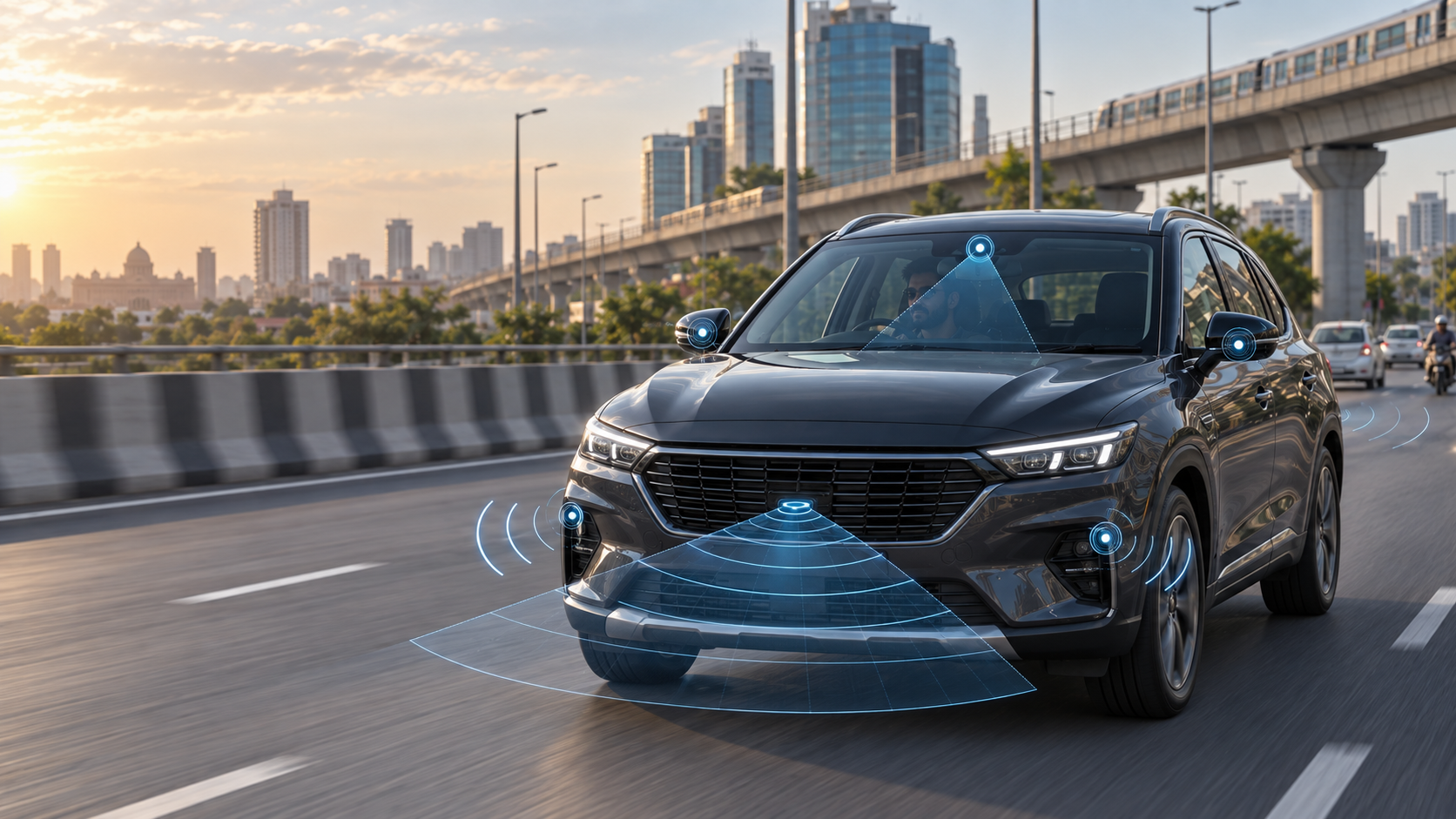
Modern driver-assistance systems take this concept even further. Cameras, radar and, on some vehicles, ultrasonic sensors continuously monitor the vehicle’s surroundings. They can identify lane markings, vehicles, pedestrians, obstacles and changes in distance or position. The system then uses that information for functions such as lane keeping, adaptive cruise control, automatic emergency braking and parking assistance.
What most drivers don’t realise is that these sensors require precise calibration to function correctly. Even a windscreen replacement on a car with a forward-facing camera requires recalibration before the ADAS systems can operate as intended. An uncalibrated system may appear to work but be operating on misaligned data. In India, where highway stone-chip damage makes windscreen replacement far more frequent than in most markets, this is a situation more Indian drivers are walking into than they realise.
One Sensor Can Influence Multiple Systems
Imagine you’re driving to work when the ABS warning light comes on. A few seconds later, the traction control warning appears. Then the dashboard tells you stability control is unavailable. It looks like three different problems. Sometimes there is only one.
A faulty wheel speed sensor can cause all of this because ABS, traction control, and stability control all draw from the same data source. When that one sensor stops sending a reliable signal, all three systems lose their input at the same time. The same principle applies to the steering angle sensor. If the car cannot get a reliable reading of where the steering wheel is pointing, any system that uses that information to understand driver intent is affected.
This is why a single small fault can produce multiple warnings simultaneously. And it is also why diagnosing a sensor fault is more complicated than replacing the part a scan tool names first. The scan tool identifies which system flagged the fault. Finding what actually caused it is a different job.
What Happens When a Critical Sensor Fails?
The first sign of a sensor failure isn’t always the car stopping. Sometimes the car simply starts behaving differently.
An engine sensor can fail and the ECU may fall back on a substitute value. The car keeps running, but you may notice rough running, weaker acceleration or higher fuel consumption. In more serious cases, the ECU reduces engine performance to protect itself.
When wheel speed sensors fail, the electronic safety net disappears quietly. The car still brakes, but without ABS, traction control, or ESC available to intervene when grip runs out.
Airbag system faults are in a different category entirely. A damaged sensor, wiring fault or incorrect signal can trigger the airbag warning light and require immediate attention. In rare cases, a false crash signal can contribute to an unintended deployment without a collision. That is precisely why a restraint system warning should never be dismissed as a minor dashboard notification.
With ADAS, the consequence can be less visible but still significant. A camera or radar that is blocked, damaged or incorrectly calibrated causes features like lane assistance or automatic emergency braking to become unavailable. The car drives normally. The safety net is gone.
What Is the Solution? How Is a Sensor Fault Actually Fixed?
A sensor warning doesn’t tell you to replace a sensor. It tells you something in the system needs to be investigated. The fault code identifies which system flagged the problem. Finding what caused it is a different job entirely.
The technician checks live sensor data against expected parameters, inspects wiring harnesses and connectors for damage or corrosion, and verifies power supply and ground integrity. The cause could be the sensor itself, a wiring fault, a corroded connector, or a problem in a connected system. Each has to be ruled out before anything is replaced.
Once the root cause is identified, the repair is carried out. Sometimes it is the sensor. Sometimes it is wiring or a connector. Sometimes the sensor is working correctly and the fault lies elsewhere.
Certain repairs also require calibration or system initialisation before the vehicle can operate correctly again. A replaced component that has not been calibrated may appear to work but be operating on incorrect reference data.
The final step is verification. The vehicle is scanned again and the system tested to confirm the fault is genuinely resolved, not just cleared.
Why Grease Monkey?
A sensor fault is one of those problems where replacing a part is often easier than finding the actual fault. You could replace the sensor, clear the warning and drive away only to have the same warning return a few days later because the real problem was never the sensor.
That is where the quality of diagnosis makes a difference.
At Grease Monkey, a sensor warning is treated as a problem to be traced, not a part to be changed. The aim is to identify what caused the fault, determine what actually needs attention and make sure the system is back to working correctly before the car leaves the workshop.
Because with a sensor fault, getting the right answer matters more than replacing the first part that gets blamed.

Leave a Reply