India was supposed to move to E20 petrol by 2030. That timeline was brought forward to 2025–26, and now E20 is already making its way into fuel stations across the country. But what does this shift mean for Indian cars and the people driving them?
E20 is petrol blended with 20 per cent ethanol, compared with the E10 blend that Indian motorists were more familiar with. On paper, the case for ethanol is strong. It can reduce India’s dependence on imported crude, support domestic agriculture and lower certain emissions from petrol. But once E20 goes into a car, the story gets more complicated. Ethanol behaves differently from petrol, which has implications for fuel economy, fuel-system components, and the long-term durability of vehicles not designed for higher ethanol blends.
Then there is the other side of the equation. Ethanol has to be produced before it can be blended into petrol, and that production comes with its own demands on water, agriculture, energy and waste management. So, how does E20 perform in the real world, and what are the trade-offs that come with the transition?
What happened when E20 reached Indian roads?
The concerns around E20 didn’t stay confined to fuel pumps for long. Once the blend became more widely available, car owners began reporting changes they could actually feel behind the wheel, including lower mileage, rough idling, hesitation and hard starts, while some owners also reported vehicle breakdowns.
The conversation quickly moved online. YouTube and social media became a running record of owners questioning whether E20 was behind what was happening to their cars. In one widely discussed case, a popular Indian content creator blamed E20 petrol for a sharp drop in his car’s performance, but later retracted the claim and issued a public apology.
In another case, a well-known creator blamed E20 for the breakdown of his Toyota Innova HyCross and alleged that the fuel had damaged the engine. Toyota’s inspection found water contamination in the fuel tank as the cause of the failure.
A car breaking down after being filled with E20 does not, by itself, prove that E20 caused the failure. Yet reports of changes in mileage, drivability and fuel-system behaviour have raised a genuine question: what exactly changes when the ethanol content in petrol goes up?
What does E20 actually do inside a car?
The first change many owners notice is fuel economy. Ethanol contains less energy per litre than petrol, which means an engine running on E20 may need to consume more fuel to deliver the same amount of energy. How noticeable the drop is depends on the engine, its calibration, driving conditions and the fuel itself.
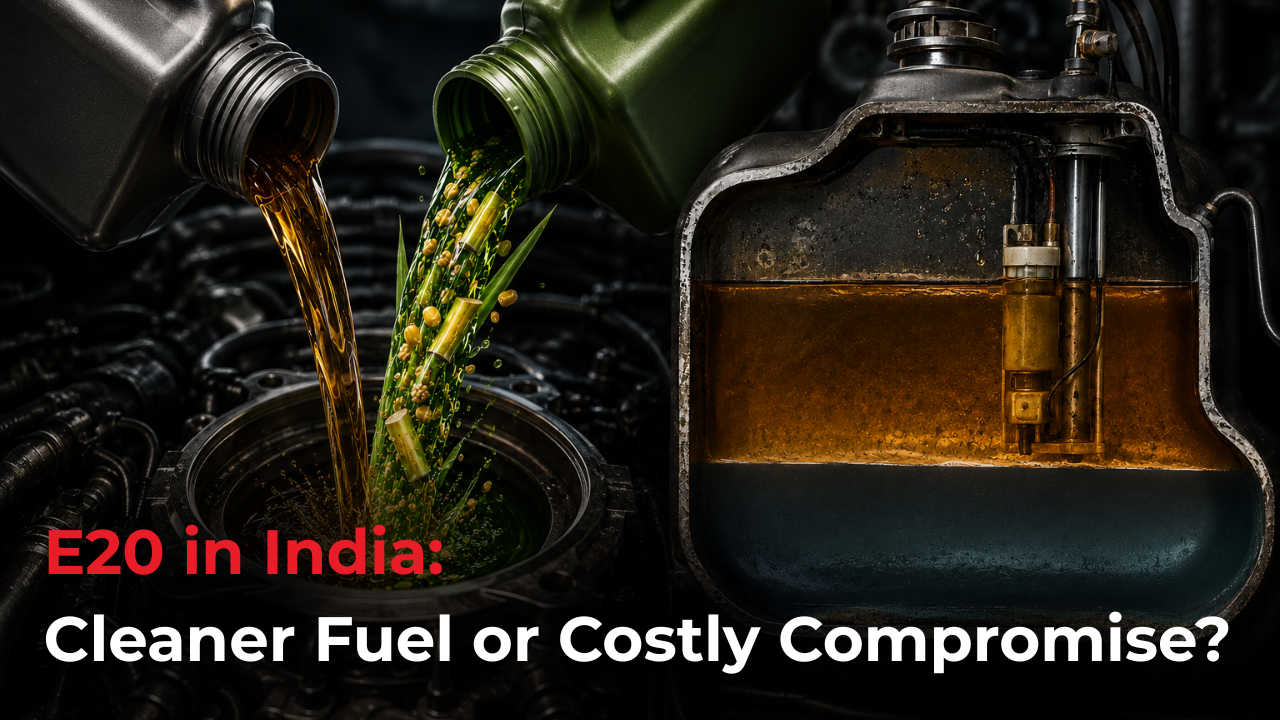
One of the biggest concerns is ethanol’s hygroscopic nature; ethanol attracts and holds moisture. If water enters the fuel system, it can contribute to corrosion in susceptible metal components, including fuel tanks, fuel lines, pumps and other parts of the system.
The same applies to seals, hoses and O-rings. Components developed around lower ethanol blends may not withstand prolonged exposure to E20 in the same way as ethanol-resistant materials. Over time, this can lead to swelling, hardening, cracking or loss of sealing performance.
Then there are the fuel pump and injectors, which have to deal with a different fuel chemistry and, depending on the design, different material compatibility and lubrication requirements. Long-term exposure can therefore become a durability concern.
Ethanol also has solvent properties. In an older fuel system, it can loosen deposits accumulated over years of use. Those deposits can then move through the system, potentially restricting filters or affecting injectors and fuel delivery.
This is why E20 compatibility is not simply about whether an engine can burn the fuel. It is about whether the entire fuel system was designed to live with it.
Ethanol production: what is its environmental cost?
E20 is often presented as a cleaner alternative to conventional petrol, particularly because ethanol blending can reduce certain emissions from fuel use. But the environmental impact of ethanol also depends on what happens before it reaches the fuel pump, from growing the feedstock to processing, distillation and transportation.
Take sugarcane. It is a water-intensive crop widely used for ethanol production. A NITI Aayog assessment estimated that producing one litre of ethanol from sugar requires roughly 3,000 litres of water, largely because of the water required to grow the crop. The assessment also highlighted the need to consider sugarcane’s water demand as ethanol production expands.
Then comes the distillery. Ethanol production generates spent wash, a high-strength wastewater containing organic matter, salts and other compounds, reflected in its high BOD and COD levels. If inadequately treated, this waste can affect soil and water quality, which is why its management remains an important environmental consideration for distilleries.
There are also concerns from communities living around some ethanol and distillery facilities. In Telangana’s Chittanur village, residents living near an ethanol plant have reported foul emissions and raised concerns about health and water quality. Distillery operations in parts of Punjab have also drawn attention from local communities, particularly around questions of groundwater quality and agricultural impact.
There is also the question of air quality around these facilities. Ethanol production involves industrial processes that can generate particulate matter and gaseous emissions, along with odour and other airborne pollutants. Managing these emissions effectively is important for maintaining air quality in surrounding areas, particularly for more vulnerable groups such as children.
And this is where the environmental side of E20 becomes more complex. The benefits and impact of ethanol ultimately depend on the entire process behind it, not just what happens once the fuel is burned in the engine.
Is India actually ready for the E20 transition?
For car owners, the E20 conversation eventually comes down to one thing: how do you keep your car healthy as the fuel around it changes?
For newer E20-compatible vehicles, the answer begins with the engineering already built into the car. But for older vehicles, preventive maintenance becomes far more important. Fuel-system components that are ageing or already showing signs of wear can become bigger concerns when exposed to higher ethanol blends over long periods.
This is where professional servicing can make a difference. Regular inspection of the fuel system, hoses, seals, injectors, fuel pump and other critical components can help identify deterioration early before a small issue becomes an expensive repair.
At Grease Monkey, this is where we come in. Our approach is focused on identifying potential E20-related issues before they turn into expensive repairs. This includes fuel-system inspections, checking for water contamination in the fuel tank, fuel-filter inspection and replacement, and injector cleaning and servicing where required. Regular checks of hoses, seals, fuel pumps and other supporting components can also help identify early signs of deterioration.
The goal is not simply to fix a problem after it appears, but to catch potential issues early and keep the engine and fuel system working reliably for the long term.
As India’s fuel landscape evolves, caring for the car cannot remain an afterthought.

Leave a Reply