“They don’t make engines like they used to.”
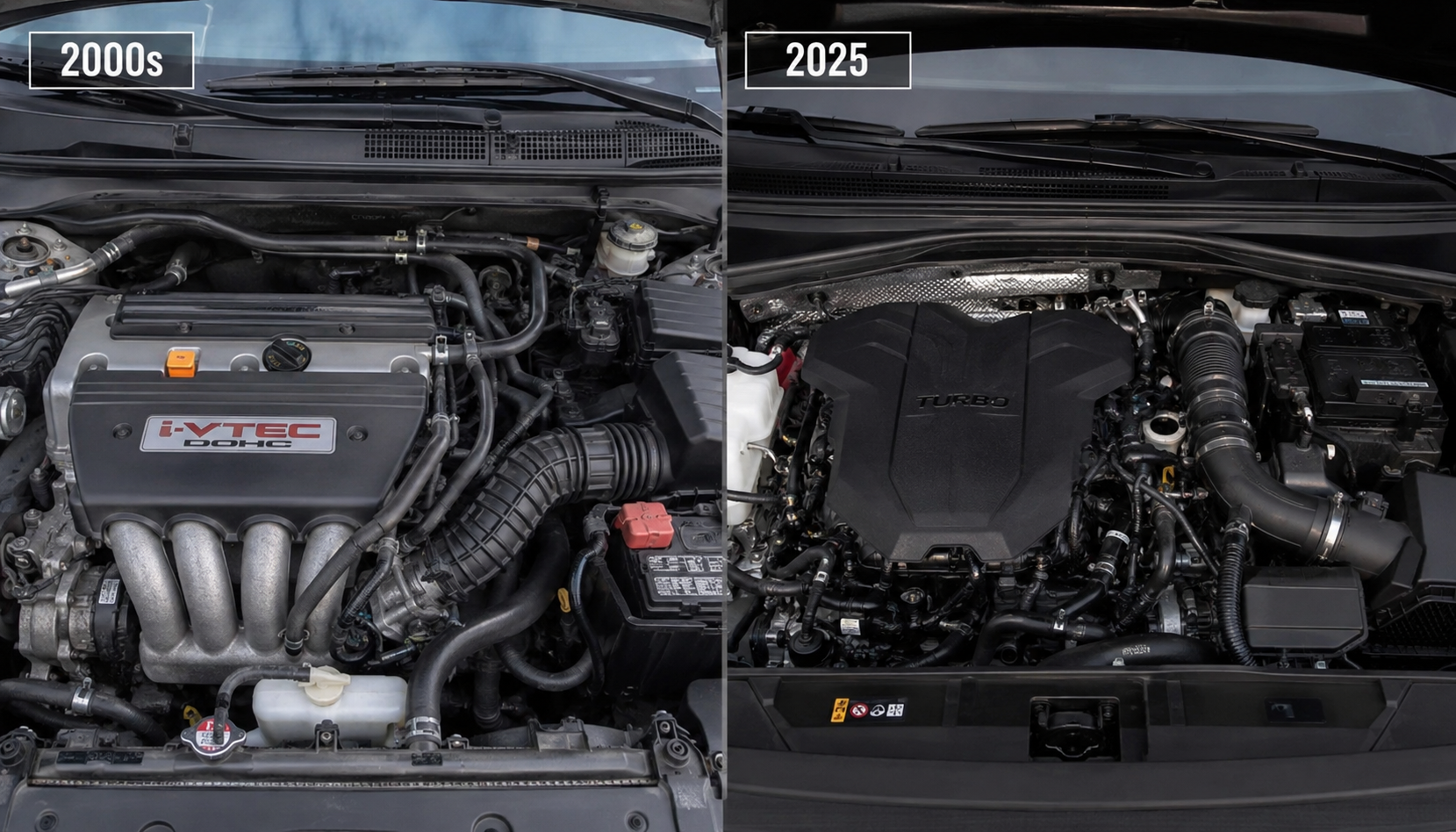
Every generation of car enthusiasts has one thing in common: they believe the engines of their era were built better. There’s some truth to that, but not for the reason most people think. Older engines weren’t necessarily stronger or better engineered; they were simply built for a different era. They were larger, mechanically simpler and designed around the technology, fuel quality and emissions standards of their time.
Today’s engines, on the other hand, are expected to produce more power from less displacement, consume less fuel, and emit significantly fewer pollutants, all while lasting just as long. In many ways, the modern engine is a far more demanding machine than its predecessor, and that shift has fundamentally changed how engines are designed, built and operated.
How Modern Engines Evolved and Why They Had To
For most of the 20th century, making an engine more powerful meant making it bigger, with more cylinders, more displacement, more fuel. It worked, but it also meant heavier cars, higher fuel consumption, and emissions that no modern standard would tolerate. By the late 1990s, that approach had run its course. Rising fuel prices and the demand for more efficient cars forced engineers to rethink the engine from the ground up.
The first thing to go was weight. Cast-iron engine blocks, heavy, slow to warm up, and poor at shedding heat, gave way to aluminium alloys that were lighter by tens of kilograms and far better at managing thermal load. Less weight meant less energy needed to move the car, and every kilogram shed from the engine contributed directly to the fuel economy improvements manufacturers were now chasing.
Displacement came down alongside it. Large naturally aspirated engines started disappearing from everyday cars, replaced by smaller turbocharged three- and four-cylinder units that could match or exceed their power output from a fraction of the capacity. A 1.2-litre turbocharged engine making what once required a 2.0-litre is no longer remarkable; it’s the norm. Volkswagen led this shift at scale with its TSI engine family from 2005, followed by Ford’s EcoBoost range from 2009. By the early 2010s, virtually every major manufacturer had a downsizing strategy in place.
Fuel delivery evolved in the same direction. In older engines, traditional port injection mixed fuel with air in the intake manifold before it entered the combustion chamber, a system that worked reliably for decades. Modern engines moved to Gasoline Direct Injection, spraying fuel directly into the chamber at extremely high pressure, at precisely the right moment, delivering cleaner combustion, better efficiency, and lower emissions. But GDI introduced a challenge port injection never had: in older engines, fuel passing over the intake valves naturally washed away carbon deposits as it flowed through. In a modern GDI engine, fuel bypasses the valves entirely, so nothing cleans them. That carbon buildup accumulates over time and becomes a maintenance reality that anyone driving a modern engine needs to understand.
Together, these changes to lighter materials, forced induction, and direct injection didn’t just make engines cleaner. They made them dramatically more powerful for their size. Twenty years ago, a typical family car produced around 50–70 horsepower per litre. Today, 80–120 horsepower per litre is standard, from a smaller, lighter package that also meets emissions standards the previous generation couldn’t come close to.
India came to this later than most markets, and honestly, for good reason. Through the 2000s and into the early 2010s, simple, naturally aspirated engines did the job fine here. Fuel was cheaper, and buyers weren’t asking for anything different. The regulations didn’t demand it either; BS4, which arrived nationwide only in 2017, didn’t force fundamental engine architecture changes. Then BS6 Phase 1 landed in April 2020, and the entire equation shifted.
India skipped BS5 entirely, jumping straight to BS6, the equivalent of Europe’s Euro 6 standard, and older engine architectures simply couldn’t meet the new emissions thresholds. Maruti brought in the K10C Boosterjet, Hyundai dropped the 1.0 T-GDi into the i20, Kia followed with the same engine in the Sonet, and Tata started its turbocharged petrol push. BS6 Phase 2 in 2023 closed the door on whatever was left of the old guard. Add climbing petrol prices and manufacturers racing to out-spec each other, and the transition happened faster here than almost anyone expected. The person buying a Baleno or an i20 today is driving an engine that has more in common with a European hatchback than anything India was selling ten years ago.
But as engines evolved, so did engine oil. The oil that worked fine in a naturally aspirated engine from 2005 was never going to be enough for a turbocharged, direct-injected unit running at twice the power density.
Why Engine Oil Had to Evolve with Modern Engines
The evolution of the modern engine didn’t just change how power is produced; it completely changed the conditions under which engine oil has to work. Today’s engines generate considerably higher thermal loads, operate with peak cylinder pressures that can exceed 100 bar in turbocharged petrol engines, are built with tighter manufacturing tolerances and are expected to maintain that performance over increasingly longer service intervals.
Under these demanding conditions, the lubricant protecting the engine had to evolve just as much as the engine itself.
Modern engine oil lubricates heavily loaded bearings, carries heat away from critical components such as turbochargers, helps maintain compression by sealing the gap between piston rings and cylinder walls, keeps combustion contaminants suspended until they’re captured by the oil filter, protects internal components against corrosion and, in many engines, even serves as the hydraulic fluid for variable valve timing systems. It has become an active engineering fluid that directly influences engine performance, efficiency and durability.
Modern formulations also contain sophisticated additive packages typically accounting for 15–30% of the oil that use detergents, dispersants, anti-wear additives, antioxidants and friction modifiers to solve different engineering challenges inside the engine.
As modern engines became cleaner, engine oil had to follow. This led to the development of Low SAPS formulations, which reduce the levels of Sulphated Ash, Phosphorus and Sulphur without compromising engine protection. Why? Because excessive amounts of these compounds can gradually contaminate sensitive emissions-control components such as catalytic converters and petrol or diesel particulate filters. For many BS6-era vehicles, Low SAPS oils are no longer optional; they’re part of the engine’s design requirements.
With E20 petrol now being introduced across India to reduce emissions and improve energy sustainability, modern engines are already operating with cleaner, more advanced fuel blends. Protecting these increasingly sophisticated powertrains, therefore, demands an equally advanced lubricant.
That’s where a 100% fully synthetic engine oil comes in. Its engineered molecular structure remains stable under extreme temperatures, resists breakdown over extended drain intervals and maintains a stronger lubricating film under high mechanical loads. Choosing the right engine oil matters more than ever.
Golden Cruiser: Grease Monkey’s Trusted Engine Oil Partner
Modern engines leave very little room for compromise, and that starts with oil. Choosing based on viscosity grade alone, 5W-30 or 0W-20, isn’t enough anymore. Two oils with the same SAE grade can differ significantly in additive chemistry, performance standards, and manufacturer approvals. Use the wrong one consistently, and the consequences build quietly: accelerated wear, sludge formation, shortened turbocharger and timing chain life, and premature degradation of emissions-control components.
That’s why Grease Monkey uses Golden Cruiser‘s 100% fully synthetic engine oils engineered specifically for modern powertrains, with the thermal stability, deposit control, and wear protection that today’s high-output, turbocharged engines actually require.
Every oil service at Grease Monkey starts by identifying the manufacturer’s recommended specification for that specific engine, not just the viscosity grade. The correct Golden Cruiser oil and a fresh filter go in, and while the engine is open, it’s inspected for oil condition, leaks, and related components that could indicate developing issues before they turn expensive.
Modern engines are remarkable, but their longevity comes down to one consistent habit: the right oil, changed at the right interval. That’s what every Grease Monkey service is built around.

Leave a Reply