Horsepower figures, acceleration times and top speeds often dominate conversations about cars. Yet none of them matters unless a vehicle can shed that speed with the same confidence and precision with which it builds it. As modern cars become quicker, heavier and more capable, the engineering challenge is no longer just making them go faster; it’s making sure they can stop safely, consistently and under complete control.
Every time you press the brake pedal, the braking system is asked to manage the momentum of a moving vehicle carrying a tremendous amount of kinetic energy. A single stop from highway speeds can require the brakes to convert nearly 0.6 MJ of kinetic energy into heat, placing enormous thermal demands on the pads, discs and brake fluid, all while keeping the vehicle stable, predictable and within the grip available at the tyres.
It is one of the most demanding tasks any automotive system performs, yet it happens countless times over a vehicle’s lifetime and is often taken for granted.
That responsibility is exactly why the braking system is classified as an active safety system. Brakes aren’t just mechanical components; they’re the only system in your car designed to prevent an accident rather than survive one. Airbags, seatbelts, and crumple zones all kick in after something goes wrong. Brakes exist, so it doesn’t. They’re also the physical foundation on which everything else builds: ABS, ESC, and Autonomous Emergency Braking; none of it works without the car’s ability to generate and precisely control braking force.
Understanding how this system works, why its components are engineered to wear, and why timely maintenance matters begins with appreciating one simple fact: every safe journey depends just as much on how confidently a car stops as on how quickly it can go.
From Your Foot to the Road: Why Brakes Work as One System
Pressing the brake pedal feels like one simple action. What it actually triggers is a carefully engineered chain of events, and the system is only as effective as its weakest link.
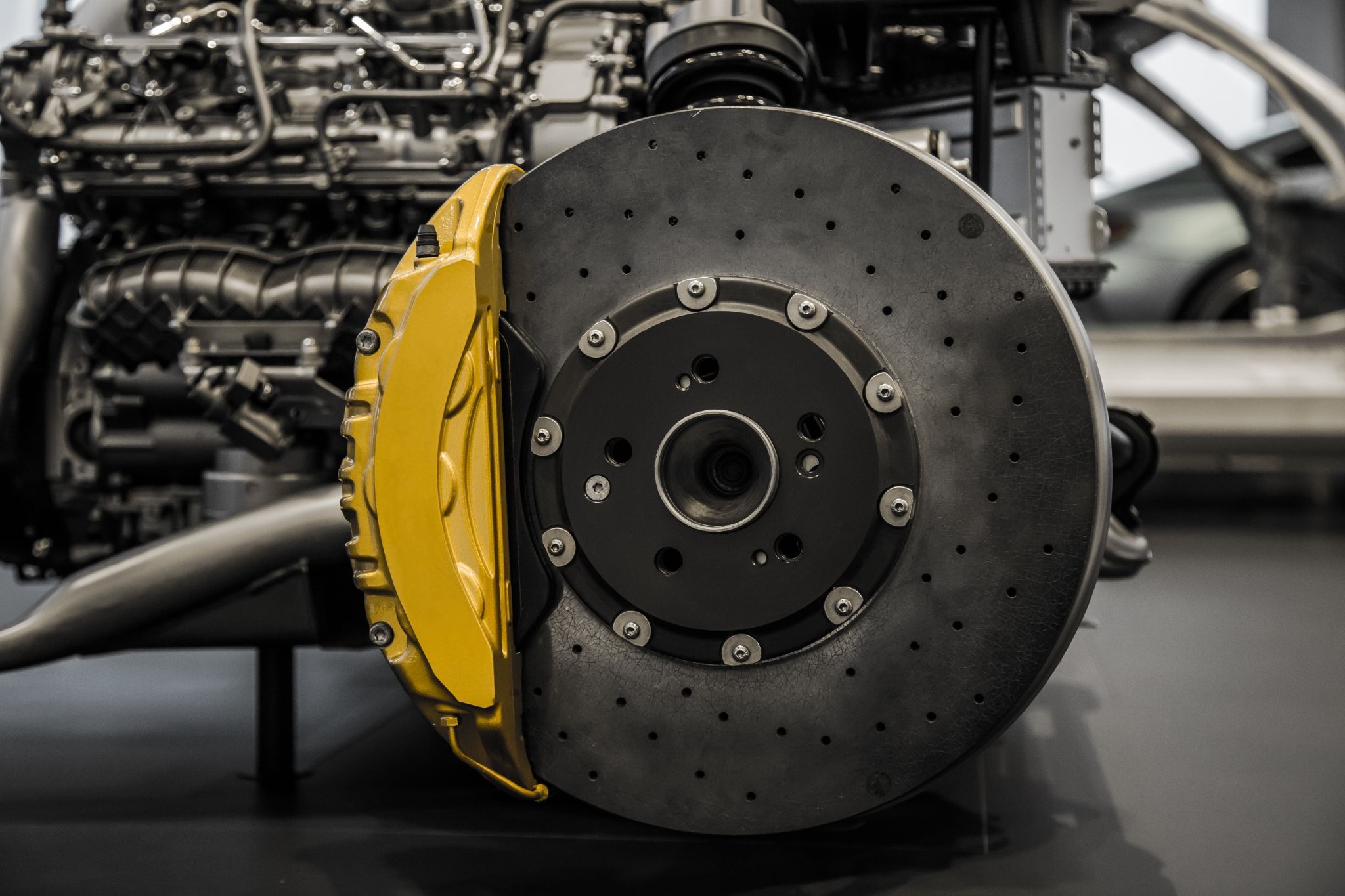
It starts at the pedal, where the brake booster amplifies the driver’s input to reduce the effort required. That force transfers to the master cylinder, which converts it into hydraulic pressure. Brake fluid is virtually incompressible, which means that pressure travels almost instantly through the brake lines to each wheel. At the callipers, it pushes pistons outward, clamping the brake pads against the rotating discs. The friction that results generates braking torque, but that alone doesn’t slow the car.
Deceleration only happens when that braking force transfers through the tyres’ contact patches to the road. The brakes create the force, and the tyres deliver it, which is why the braking system has to be treated as one complete assembly, not a collection of individual parts.
Worn pads, deteriorated brake fluid, sticking callipers, damaged discs, any one of them can compromise how effectively the system generates and delivers braking force, and ultimately, how safely and predictably the car actually stops.
The Engineering and Physics Behind Braking
Braking also changes how the car behaves in real time. As it decelerates, inertia pushes the weight forward onto the front axle, increasing front tyre grip while reducing it at the rear. That’s why front brakes are larger and more powerful than rear ones, why front pads and discs wear faster in normal driving, and why engineers spend considerable effort calibrating brake bias, the front-to-rear braking balance, to keep the car stable under heavy braking.
Then there’s heat. Every brake application raises the temperature of the discs and pads, and managing that heat is one of the core challenges in brake design. On a regular car in stop-start city traffic, repeated braking can push disc temperatures well past 200°C, and under sustained heavy use, like a hill descent, performance car discs can exceed 500–600°C. Ventilated discs, internal cooling vanes, and specialised friction materials all exist to manage this. When heat builds faster than it can dissipate, braking efficiency drops, which is brake fade, and it’s exactly as dangerous as it sounds.
In India, these thermal demands are particularly unforgiving. Dense city traffic means the brakes are constantly working, with short, frequent applications that don’t give the discs enough time to cool between stops. Then there are hill station routes: Manali, Coorg, Munnar, where drivers descend long gradients with sustained brake pressure, generating the kind of continuous heat buildup that is one of the most reliable triggers for brake fade. Two very different driving environments, but both place the braking system under exactly the kind of thermal stress that worn pads, degraded fluid, or neglected discs handle poorly.
Stopping distance makes the stakes even clearer. Speed and stopping distance don’t scale linearly; they scale with the square of speed. A car travelling at 100 kmph needs roughly four times the stopping distance of one doing 50 kmph. Which means a braking system that’s even slightly compromised, worn pads, degraded fluid, or a sticking calliper has consequences that multiply the faster you’re going.
Regenerative braking in hybrid and electric vehicles recovers energy during deceleration, which reduces how often the friction brakes are called upon. But reduce isn’t the same as replace. The moment maximum stopping performance is needed, such as an emergency stop, a sudden obstacle, or repeated high-speed braking, the friction brakes take over entirely. No regenerative system can match that response.
Brakes Are Designed to Wear, That’s Why Preventive Maintenance Is Crucial
Brake pads are designed to wear, and that’s not a flaw; it’s the point. They’re sacrificial by design, taking the punishment so the more expensive components underneath don’t have to. Discs wear too, gradually thinning until they hit the manufacturer’s minimum thickness. Both have finite lives, and both are supposed to.
The tricky part is that none of it is visible from the driver’s seat. A few tenths of a millimetre lost from a pad or disc is impossible to feel until the wear has already gone too far.
Brake fluid is the other side of that problem. It’s hygroscopic, which means it pulls moisture from the air over time, and as that moisture content rises, the fluid’s boiling point drops. A lower boiling point means brake fade arrives earlier and at lower temperatures than the system was built for. Most manufacturers recommend a full fluid change every 2 to 3 years or 30,000 to 45,000 km. In India, where monsoon humidity is relentless for months, that interval deserves more attention than it typically gets. The degradation doesn’t announce itself; it just quietly chips away at the system’s safety margin until enough of it is gone.
By the time you’re hearing squealing, feeling vibration through the steering wheel under braking, or seeing a warning light, you’re already past the point of early intervention. Those aren’t reminders. They’re late notices. Brakes don’t need to feel wrong to need attention. Periodic inspections exist precisely because the system can be losing its safety margin quietly, with nothing to show for it from the driver’s seat. Catching that early is the whole point.
Grease Monkey Takes the Guesswork Out of Brake Servicing
Proper brake servicing starts with understanding what’s actually happening, not assuming what needs replacing. At Grease Monkey, every brake service begins with a comprehensive inspection of the entire braking system before a single recommendation is made.
Pads are measured for remaining friction material and examined for wear patterns. Discs are assessed against the manufacturer’s minimum thickness specification; surface appearance alone is never a reliable indicator of condition. Callipers are inspected too, because uneven pad wear is frequently a symptom of calliper behaviour rather than pad quality alone, and replacing pads without addressing the root cause simply accelerates the next replacement.
Brake fluid receives the same rigour. As it absorbs atmospheric moisture over time, its boiling point progressively drops and under sustained or emergency braking, that degradation matters. For fluid replacement, Grease Monkey uses Golden Cruiser QuikStop Brake Fluid, one of the best in its class. Its high boiling point keeps braking consistent under intense heat, its low viscosity ensures immediate hydraulic response the moment you press the pedal, and its corrosion inhibitors actively protect braking components over the long term. It’s the kind of fluid that earns its place in a professional service.
Your braking system is the single most safety-critical system on the vehicle. At Grease Monkey, it’s treated that way with precise inspection, quality components, and servicing decisions based on actual condition, not assumption.
Visit Grease Monkey today for a brake inspection and fluid service.

Leave a Reply