Replacing engine oil is one of the most common maintenance jobs on a petrol car. An electric car never needs an oil change, but does that make it maintenance-free? Not even close.
A petrol engine contains hundreds of moving components like pistons, connecting rods, crankshafts and more. An electric motor, by comparison, is simply a rotor, some bearings, and none of the intricate internal engine components that make a petrol engine so demanding to maintain. Yet every major EV manufacturer still recommends regular servicing because eliminating the engine doesn’t eliminate the need for servicing; it simply shifts the focus to electrical and electronic systems.
Take the battery thermal management system, for example. Many modern EVs rely on a liquid cooling system that uses a manufacturer-specified glycol-based coolant to regulate the temperature of the battery, electric motor, and power electronics. However, this does not mean a refill is not required; this fluid gradually degrades over time and typically requires a complete flush and replacement every 30,000–60,000 km, depending on the manufacturer and model.
Electric vehicles are no longer a niche in India; they’re in the next parking spot. EV retail sales crossed 24.5 lakh units in FY2026, growing 24.6% over the previous year. Electric passenger vehicle sales in India crossed 1.99 lakh units in FY2026, growing 83.6% over the previous year, the strongest growth of any EV segment in the country. Tata Motors leads at around 39%, followed by JSW MG Motor at roughly 27% and Mahindra & Mahindra at approximately 21%. The Nexon EV, Punch EV, Mahindra BE 6, XEV 9e, and MG ZS EV are now everyday sights on Indian roads.
Why Is EV Servicing Fundamentally Different?
EV is serviced because the systems involved are too consequential to leave unmonitored.
At the centre of every EV sits the high-voltage battery pack, the single most expensive component in the car, typically accounting for 30 to 40% of its total cost. To put that in perspective, replacing a degraded battery pack in many cases costs more than a full engine rebuild on a conventional petrol car. These aren’t components you want to discover are failing through a breakdown on the expressway.
Here’s what makes EV servicing genuinely different: most of the systems that matter give absolutely no visible warning when something starts going wrong. Battery cells drifting out of balance, high-voltage cable insulation beginning to break down, coolant in the thermal circuit losing its corrosion-inhibiting properties, a firmware parameter the manufacturer has already identified as suboptimal, none of it shows up on your dashboard. It shows up in diagnostics. And catching it there is the difference between a software update, a coolant flush, and a battery pack replacement.
That’s really the logic behind the 12-month or 10,000 to 15,000 km service interval, not because something is guaranteed to be worn out, but because that’s the window where early intervention is still simple. By the time an EV owner actually notices something is wrong, that window has usually already closed.
Inside an EV service…
1) High-Voltage Battery & Battery Management System
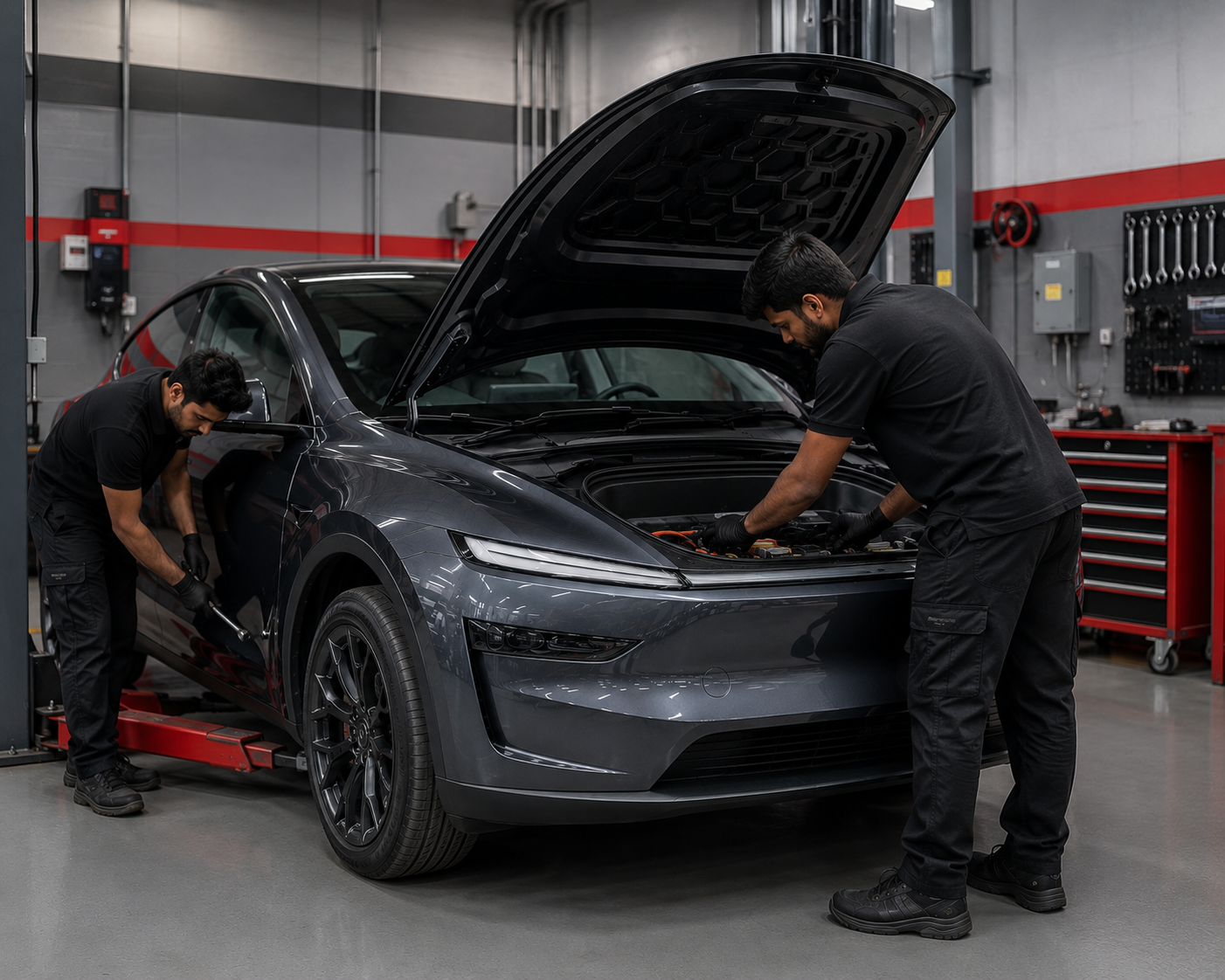
Technicians don’t crack open the battery pack; it’s a sealed unit by design. What they do is connect diagnostic equipment directly to the Battery Management System, and the onboard computer monitors every cell in the pack. The BMS tracks individual cell voltages, temperatures, and charge states continuously. Over time, cells drift, some holding charge better than others, and that imbalance quietly accelerates deterioration across the whole pack if left unaddressed. A technician checks whether cells are balancing correctly, pulls fault codes that never triggered a dashboard warning, and runs electrical isolation testing, verifying the high-voltage system remains properly separated from the vehicle’s chassis. That last check has no equivalent in a petrol car service, and it matters as much for the technician’s safety as it does for the car.
2. Thermal Management System
The battery, electric motor, and power electronics all generate heat under load, and all three are cooled by the same glycol-based liquid cooling circuit. While EV coolants may use ethylene glycol and water as their base, much like conventional automotive coolant, their electrical conductivity and material compatibility must meet the vehicle manufacturer’s specifications. During a service, technicians inspect this circuit for coolant condition, concentration levels, and signs of contamination or leakage. Glycol degrades over time, losing its thermal conductivity and corrosion-inhibiting properties. The expansion tank, pump operation, and coolant temperature sensor readings are also checked. In a system where thermal stress is one of the primary drivers of long-term battery degradation, the cooling circuit is one of the most consequential things a technician inspects.
3) Software Diagnostics
Modern EV servicing involves a level of software interaction that has no real equivalent in conventional car maintenance. Technicians run full diagnostic scans across every control module in the car, including the BMS, motor controller, thermal management controller, charging system, and ADAS modules where fitted. They’re looking for logged fault codes, sensor drift, and communication errors between systems that wouldn’t show up any other way.
Any pending manufacturer firmware updates are applied at this stage. On an EV, a firmware update isn’t cosmetic; it can recalibrate thermal management thresholds, adjust charging curves to reduce battery stress at high states of charge, modify regenerative braking maps, or correct sensor misreadings that affect range estimation. These updates are typically released in response to real-world data the manufacturer collects from the fleet, which means skipping them isn’t neutral; it means the car continues operating on parameters the manufacturer has already identified as suboptimal.
4) Braking, Suspension & Steering
The powertrain is electric. The chassis isn’t. Suspension, steering components, wheel bearings, and tyres wear on exactly the same schedule as any conventional car, with the same inspection intervals, no exceptions. Brakes are where it gets interesting. Regenerative braking handles most deceleration in normal driving, so friction brakes see far less use and pad wear is noticeably reduced. But that’s precisely why inspections become more important, not less. Callipers that rarely engage can seize. Rotors that rarely build heat can corrode from the outside in. An EV’s brakes can look completely fine and be hiding a problem that only shows up when you actually need them.
Are Electric Cars Simpler or More Complicated to Service?
The answer depends entirely on what you mean by simple. From a mechanical standpoint, yes, fewer parts, fewer wear items, fewer routine replacements. But mechanical simplicity doesn’t mean the car is easier to work on.
Modern EVs operate on 300–800V high-voltage architectures. Before a technician can work on certain components, the high-voltage system has to be safely isolated, verified as de-energised, and handled using insulated tools and PPE designed specifically for high-voltage environments. None of that exists in conventional car servicing; it’s an entirely different working environment with genuine safety consequences if the procedures aren’t followed correctly.
The diagnostic side has shifted just as significantly. Traditional servicing leaned heavily on mechanical intuition, unusual noises, fluid condition, and faults you could identify by feel or sound. EV servicing is data-driven. A technician’s diagnosis begins with manufacturer software communicating with dozens of electronic control units, pulling battery parameters, thermal performance data, charging behaviour, and fault histories that a visual inspection would never reveal.
That’s why specialised training isn’t optional. A technician with decades of experience on petrol engines doesn’t automatically qualify to work on an EV. High-voltage certification, electrical safety procedures, and familiarity with manufacturer-specific diagnostic platforms are prerequisites, not additions. Most manufacturers won’t permit a technician to work on their EVs without it.
So the short answer is that this routine maintenance on an EV is simpler. Professional servicing is considerably more specialised, and that makes the technician’s training and diagnostic capability more important than ever.
Advanced Servicing for the Next Generation of Cars
The automotive industry is evolving rapidly, and so are the skills required to service it. Whether it’s a petrol, diesel, hybrid, or electric vehicle, modern servicing demands far more than routine maintenance; it requires technical expertise, advanced diagnostics, and a commitment to following manufacturer-recommended procedures.
At Grease Monkey, we’ve built our workshop around exactly that philosophy. Our technicians are trained to work across both conventional and next-generation vehicles, supported by specialised diagnostic equipment, high-voltage safety protocols, and the technical knowledge needed to service today’s increasingly sophisticated automobiles with confidence and precision.
We don’t believe in one-size-fits-all servicing. Every vehicle is assessed based on its engineering, its condition, and the manufacturer’s recommendations, ensuring it receives the care it was designed to receive, not just the service it has always been given.
Visit Grease Monkey today!

Leave a Reply